Loading...


Loading...
Dive into the exciting world of Math Speed, the fast-paced mental math game designed specifically for kids aged 10 to 12 that transforms arithmetic practice into a thrilling speed challenge. Instead of reading plain numbers, players count dice-style dot patterns to determine values and then rapidly perform addition, subtraction, or multiplication operations to select the correct answer. This unique visual approach engages subitizing skills alongside arithmetic fluency, creating a comprehensive math training experience that strengthens both number sense and calculation speed. Perfect for elementary school students looking to sharpen their mental math abilities, parents seeking effective math practice tools, and teachers looking for engaging classroom activities, Math Speed delivers the ideal combination of educational value and competitive fun for comprehensive arithmetic development. Every session tracks correct answers, wrong answers, average response time, and total time, giving kids clear feedback on their improvement and motivating them to beat their personal records with each new attempt through this highly engaging and educationally proven approach to mental math mastery.
• Visual dice-style dot patterns replacing written numbers for engaging subitizing practice • Multiple math operations including addition, subtraction, and multiplication challenges • Multiple difficulty levels progressing from simple single-operation to complex multi-step problems • Real-time performance tracking with correct answers and wrong answers counters • Average response time and total time measurement for personal improvement tracking • Multiple choice answer format for fast and intuitive response selection • Kid-friendly colorful interface optimized for ages 10 to 12 • Instant feedback system showing right and wrong answers after each question • Progressive difficulty ensuring children are always appropriately challenged • Completely free access to professional-quality educational math gaming experience
At ages 10 to 12, children are developing the mental math fluency that underpins success in middle school mathematics and beyond. Math Speed targets this critical developmental window by combining subitizing - the visual recognition of quantities through dot patterns - with timed arithmetic challenges that build calculation automaticity. When children can quickly and accurately perform addition, subtraction, and multiplication without labored counting, they free up cognitive resources for higher-order math concepts like fractions, algebra, and geometry. Regular practice with Math Speed helps kids develop the confident, automatic number sense that makes advanced mathematics more accessible and enjoyable throughout their academic journey.
Playing Math Speed regularly builds mental arithmetic fluency, improves subitizing and visual number sense, develops concentration and focus under mild time pressure, strengthens working memory for holding and manipulating numbers, and builds mathematical confidence for classroom performance. The game's dot pattern approach mirrors proven educational techniques like rekenrek and ten-frame methods used by mathematics educators worldwide. These cognitive and academic benefits directly support improved performance on timed math tests, faster completion of homework assignments, greater confidence in mental calculation, and stronger preparation for middle school mathematics curriculum requirements. Parents and teachers alike recognize the value of timed math practice for building the arithmetic automaticity that serves children throughout their entire mathematical education from elementary through high school and beyond.
Subitizing - the ability to instantly recognize small quantities without counting - is a fundamental mathematical skill that research shows strongly predicts later math achievement. Math Speed develops this skill by presenting quantities as dot patterns similar to dice faces, training children to instantly perceive values rather than laboriously counting individual units. Combined with arithmetic operations, this creates a powerful dual-skill training effect that simultaneously improves quantity perception speed and calculation fluency. Children who develop strong subitizing skills through practice with games like Math Speed show measurable improvements in overall mathematical reasoning, mental calculation speed, and number sense across all areas of elementary and middle school mathematics.
Test your mental math skills with visual dot counting!
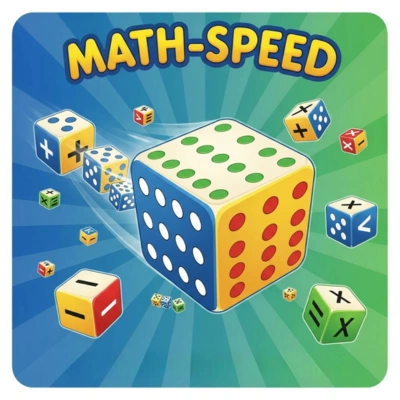
Math Speed is a fast-paced mental math game where kids count dots on dice-style patterns and solve arithmetic operations as quickly as possible. I can tell you it's one of the best math practice games for upper elementary kids who want to sharpen their calculation speed while genuinely having fun.
Math Speed is an interactive mental arithmetic challenge designed specifically for kids ages 10-12. Instead of showing plain numbers, the game displays dice-style dot patterns on screen. Kids count the dots, figure out the number each pattern represents, then perform the given math operation - addition, subtraction, multiplication, or division, and select the correct answer from multiple choices.
Unlike regular math drills or worksheets, Math Speed feels like a genuine game because dot patterns add a visual recognition challenge on top of the arithmetic.
This is what makes Math Speed unique compared to regular math games. Instead of seeing "6 × 4," kids see dice faces showing six dots and four dots. They must mentally recognize the dot patterns and calculate simultaneously, two cognitive tasks at once.
The game shows two dice-style dot patterns on screen along with a math operator (+, -, ×, ÷). Kids must first count the dots on each pattern to identify the numbers, then solve the operation and tap the correct answer from the multiple choice options shown.
This is what makes Math Speed unique compared to regular math games. Instead of seeing "6 × 4," kids see dice faces showing six dots and four dots. They must mentally recognize the dot patterns and calculate simultaneously, two cognitive tasks at once.
Look at both dice-style patterns and quickly count the dots on each. With practice, kids stop counting one-by-one and start recognizing patterns instantly, just like reading numbers on a real dice.
Read the operator between the two dice (+, -, ×, ÷). Each round may give different operations, so paying attention to the operator is crucial.
Perform the calculation in your head. No calculators, no paper, this is pure mental math. For example, if you see 6 dots and 4 dots with a multiplication sign, the answer is 24.
Tap the correct answer from the multiple choice options before time pressure builds. Speed matters, the game tracks how long each answer takes.
After each round, review your correct answers, wrong answers, average time, and total time. Challenge yourself to improve these stats with every session.
Kids try to rush through dot counting to save time, which caused errors. That fast pattern recognition comes with practice, accuracy first, then speed. Their score will be improved significantly once they focused on getting answers right before worrying about time.
Learn to recognize dice dot patterns without counting one-by-one. A real dice has standard patterns - six is two columns of three, five is four corners plus center, four is four corners. Once your eyes automatically read these patterns, your speed jumps dramatically.
If the game lets you choose, begin with addition and subtraction before tackling multiplication and division. Building confidence with easier operations first means better scores and less frustration when you face harder ones.
For multiplication, use known tricks - anything multiplied by 5 ends in 0 or 5, double-and-halve for even numbers. For example, 6 × 4 = double 6 twice = 12 × 2 = 24. These shortcuts save mental calculation time.
Ten minutes of daily Math Speed practice beats one hour once a week. My son plays 3-4 rounds every morning, and his average response time dropped from 8 seconds to 4.5 seconds in just three weeks of consistent practice.
Absolutely! Math Speed is perfectly designed for upper elementary and middle school students. My 11-year-old has been playing for two months, and both his math teacher and I have noticed significant improvement in his classroom calculation speed. He recently finished a multiplication speed test at school faster than he ever had before.
Kids aged 10-12 are at a critical stage for building math fluency. They're learning multiplication tables, long division, and operations that require fast recall. Math Speed targets exactly these skills through engaging, competitive gameplay that feels nothing like traditional drills.
The game covers all four core operations that dominate 5th and 6th grade math. Addition and subtraction for problem-solving, multiplication for area and ratio work, division for fractions and algebra foundations. Improving speed in these fundamentals makes every area of school math easier.
Math Speed contains no inappropriate content, no social features, and no external links. It's completely focused on mathematical practice
As a parent and former educator who's watched my son play Math Speed consistently for two months, I can confirm it genuinely improves academic math performance.
Dot Pattern Recognition: The dice-style visual element develops a form of number sense that pure number drills don't build. My son now "sees" quantities as patterns rather than just digits. This visual-numerical connection strengthens number sense, which underpins all higher math thinking.
Mental Math Confidence: Before Math Speed, my son reached for a paper-pen for basic multiplication. After two months, he solves most calculations mentally without hesitation. This confidence ripples into every area of school math, he attempts problems he'd previously avoid.
Attention and Focus: Each round requires sustained concentration, count dots, identify operation, calculate, select answer, all under time pressure. Regular practice has improved ability to focus on multi-step tasks.
Working Memory: Holding dot counts in mind while performing calculations exercises working memory directly. Strong working memory is crucial for multi-step math problems, reading comprehension, and following complex instructions, skills that matter throughout middle and high school.
Exam Preparation: Speed and accuracy under pressure are exactly what math exams test, significantly more comfortable with timed math situations.
The dot pattern visual element adds an extra cognitive layer that number-only drills lack. Kids develop both rapid number recognition and calculation speed simultaneously. It's more engaging than worksheets because of the competitive time-tracking and the visual puzzle element of reading dot patterns.
Math Speed covers all four core operations - addition, subtraction, multiplication, and division. Different difficulty levels adjust which operations appear and the complexity of numbers involved.
Yes, noticeably. My son's performance on timed classroom math tests improved within six weeks of daily play. Speed and accuracy under pressure are exactly what school tests measure, and this game builds both in a genuinely engaging way.
I recommend 10-15 minutes per session for kids aged 10-12. This is enough to get meaningful practice without mental fatigue. My son plays one session in the morning and sometimes a quick round after homework. Multiple short sessions beat single long ones for building speed and retention.
Yes! The game shows correct answers, wrong answers, average time per question, and total session time.
Absolutely, and it's especially valuable for them. The visual dot patterns provide a concrete representation of numbers that struggling learners benefit from. Start with addition on easy settings and build confidence before progressing.
Math Speed is one of the most genuinely effective math practice games I've found for upper elementary students. It makes calculation practice competitive and engaging. Kids aged 10-12 preparing for math exams, students who need to improve multiplication and division speed, competitive kids who respond to performance tracking, parents wanting productive screen time, teachers looking for engaging homework alternatives.
The game respects this age group's need for challenge and measurable progress. Math Speed turns math practice from a chore into a personal challenge. Give your child one week of daily sessions before judging, most kids at this age get hooked by the competitive statistics.


